Let’s Revive
Orange Business dives into regeneration

Orange Business dives into regeneration
On World Ocean’s Day 2023, Orange Business launched the “Let’s Revive” program, in partnership with Tēnaka, expert in coral reefs restoration.
Through our collaboration with Tēnaka, we will support the conservation of a fragile, but so vital ecosystem, lying just beneath the surface of the sea. We have funded the restoration of a 1,500m² coral farm and we will support Tenaka with our technology expertise to enhance and scale their operations.
Being at the forefront of digital technology, we strongly believe that every technological advance must be useful to man, society and the planet.
Click on the video on the left for a short introduction about our program!

Through a pluriannual partnership, we aim at restoring nearly 5,000sqm of damaged coral in the Coral Triangle, with multiple benefits on people and natural ecosystems.

Tēnaka will scale up and digitalize their operations by leveraging Digital & Communication Services of Orange Business.
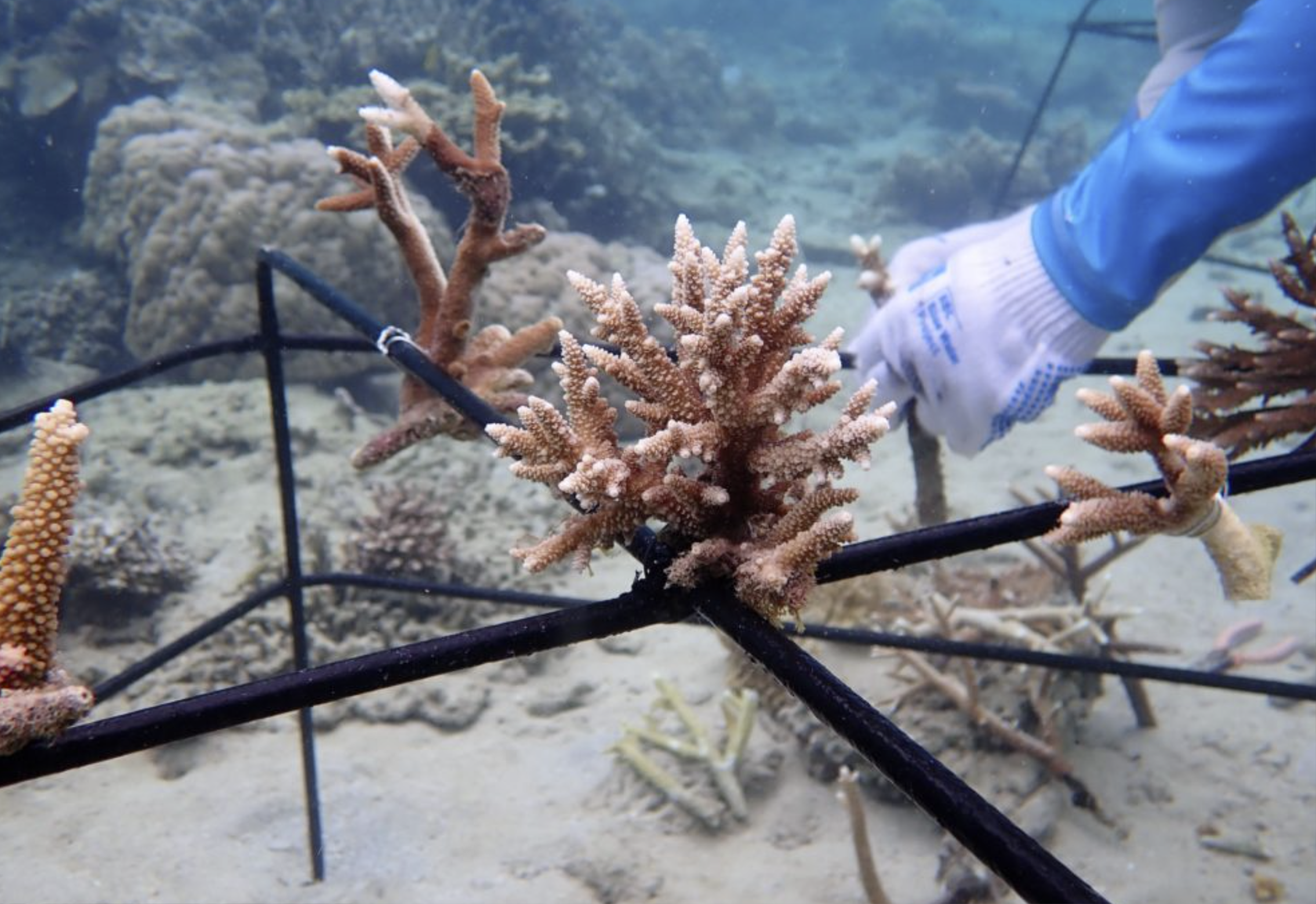

Coral reefs are often referred to as the “rainforests of the sea” because of their incredible biodiversity. They are home to countless species of fish, invertebrates, and other marine life, many of which are found nowhere else on Earth. Coral also plays a crucial role in the health of our planet’s oceans. They help regulate the carbon and nitrogen cycles, provide protection from storms and erosion, and are a vital source of food and income for millions of people around the world.

of marine biodiversity uses coral reefs as natural shelters
of Earth’s oxygen comes from the ocean (produced by oceanic plankton)
absorbs the CO2 equivalent of 6,000 trees over its lifetime
of coral reefs have already disappeared & 50% of the remaining ones are at threat by 2050
of the worlds’ CO² emission is absorbed by the ocean, which makes it the biggest Earth carbon sink (vs ‘only’ 14% for the forests)
People depend directly on coral reefs for their survival
Opt for snorkeling destinations that promote coral reef conservation and have well-managed marine protected areas.
Avoid touching or standing on the corals, as they are delicate and easily damaged. Instead, swim parallel to the reef or float above it while observing the marine life.
Opt for reef-safe sunscreens that are free from oxybenzone, octinoxate, and other chemicals harmful to marine life. Look for mineral-based sunscreens that use zinc oxide or titanium dioxide.
Feeding fish can disrupt their natural behavior and cause an imbalance in the ecosystem. It’s best to observe marine life without interfering or feeding them.
If you’re on a boat, ensure that the captain or crew anchors in sandy areas away from coral reefs. Anchoring on corals can cause irreparable damage.
Carry a reusable water bottle and avoid using single-use plastics. Dispose of any waste in designated trash receptacles onshore and make sure nothing is left behind in the water or on the beach.
Consider joining guided snorkeling tours led by local experts. They can provide valuable insights, educate you about the reef ecosystem, and ensure you follow sustainable snorkeling practices.